Lo-Kout: Guide, Warrior, and Historical Witness
Lo-Kout was born about 1834 into a prominent Yakama family. He was a son of Chief Ow-hi and a half-brother of Qualchan; through his mother he was a grandson of the Columbia River leader Talth-scosum, also rendered Sulktalthscosum. His name appears in the historical record in many forms, including Lokout, Lo-kout, Loolowcan, Luqaiot, Laquoit, Quo-to-we-not, and Soka-tal-ko. That variety is not unusual: Indigenous names were written phonetically by English-speaking observers, and Lo-Kout later told Jack Splawn that he changed his name during the war.
A Childhood Across the Northwest
Lo-Kout’s family homeland lay around Wenas, Selah, and Naches, but his childhood was not confined to one valley. His family traveled west to Puget Sound to visit relatives, trade, and gather food, and east across the Rocky Mountains to hunt buffalo. His half-sister Mary Moses recalled an expedition in 1847 or 1848 during which their grandfather was killed in a seven-day battle with the Blackfeet. These journeys placed Lo-Kout within a far-reaching Indigenous world of family ties, trade routes, hunting grounds, and military alliances.
“Loolowcan,” Guide to Theodore Winthrop
In 1853, when he was about nineteen, Lo-Kout was camped near Fort Nisqually with his father. Ow-hi agreed that his son, then known as Loolowcan, would guide the young American traveler Theodore Winthrop over the Cascade Mountains toward The Dalles. Winthrop’s later account is insulting and openly racist, yet it also records the young man’s ability. He called Loolowcan an experienced guide and linguist and conceded that his memory and observation were “unerring.” Lo-Kout led the party over the difficult Naches Pass trail and communicated with Winthrop in Chinook Jargon.
Their relationship deteriorated badly. Winthrop described Loolowcan as selfish and treacherous, while also admitting that the white road workers treated him with prejudice. More than fifty years later, Lo-Kout gave Splawn the other side of the story. He said Winthrop became increasingly cross, kicked him “as if I was a dog,” and drew a revolver when Lo-Kout refused to continue beyond Wenas Creek. The two accounts reveal not only a personal quarrel but the unequal and increasingly violent relationship between American travelers and the Indigenous people whose country they were entering.
Resistance, 1855–1858
After the treaty councils of 1855 and the accelerating entry of miners and settlers, Lo-Kout fought alongside Qualchan and other Plateau leaders resisting the loss of their lands. Splawn placed him at the fighting near Toppenish and Union Gap, the Battle of Walla Walla, the attack on Governor Isaac Stevens’s party, the Battle of Seattle, Connell’s Prairie, and the defeat of Lieutenant Colonel Edward Steptoe in 1858. Not every part of that list can be independently verified, so it is best read as Splawn’s record of Lo-Kout’s recollections rather than as a complete military service record.
Splawn also tells of a revealing moment on the Naches River in 1856. Ashamed that Ow-hi was seeking peace, Lo-Kout crossed alone into Colonel George Wright’s camp and declared himself ready to die so that the war would continue. Wright sent him back alive, and the next day Lo-Kout returned as one of his father’s peace messengers. The speech Splawn assigns to him appears below. Its ideas may preserve Lo-Kout’s memory, but its polished English was almost certainly translated and shaped by the author.
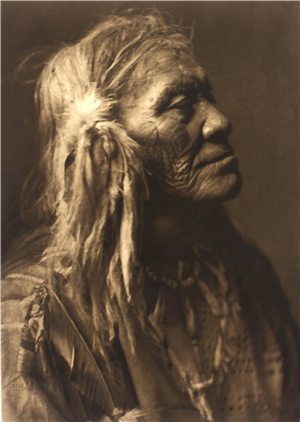
Lo-Kout told Splawn that seven bullets had passed through his body. In fighting near Walla Walla he was reportedly shot twice in the chest and struck in the forehead with a rifle stock after he had fallen. The deep depression visible in later photographs supports the existence of the head injury, although the exact circumstances survive chiefly through Splawn’s account.
Qualchan’s Death and the Years After War
Lo-Kout accompanied Qualchan and Qualchan’s wife to Colonel Wright’s camp in September 1858. Wright had Qualchan hanged within minutes. What happened to Lo-Kout next is disputed. Splawn says soldiers bound him and placed a rope around his neck before a Colville man cut him loose, allowing him to escape on Qualchan’s horse. Another tradition says that a Spokane man vouched for him and secured his release. The surviving evidence does not settle the difference.
Lo-Kout later married Qualchan’s widow, whose name is rendered in the records as Whist-alks, Whisto, Swista, and in other forms. They lived for a time among the Flathead people and eventually settled near the mouth of the Spokane River, on the Spokane Reservation. Splawn wrote that Lo-Kout joined later warfare on the Plains and was present at the Battle of the Little Bighorn in 1876. No independent evidence yet located confirms that claim, so it should remain identified as family testimony recorded by Splawn, not as an established fact.
An Elder Remembering the Past
In 1906 Splawn visited Lo-Kout near Fort Spokane and interviewed him at length. When Splawn asked if he had been Winthrop’s guide, the old man answered, “Yes, I was then Loolowcan, but changed my name during the war later.” Edward S. Curtis photographed him in profile in 1910 for The North American Indian. A modern biographical account says that Curtis also interviewed him, but a separately identified transcript of such an interview has not yet been located. Curtis’s portrait nevertheless provides a powerful visual record of Lo-Kout late in life.
Lucullus Virgil McWhorter is probably the ethnologist whose name is associated with this story. McWhorter lived in the Yakima Valley, gathered Indigenous oral histories, and preserved extensive material about Ow-hi, Qualchan, and the Yakama wars. However, the published finding aid for his papers does not identify a direct interview with Lo-Kout under any of Lo-Kout’s known names. Until such a document is found, McWhorter is best treated as an important related archive rather than as a confirmed interviewer.
Lo-Kout died in 1913 according to the biographical record used by HistoryLink; Splawn gave 1914 and an age of eighty-five. Even the uncertainty over these basic dates shows the difficulty of reconstructing an Indigenous life from records created mainly by non-Indigenous writers. Read together, however, Winthrop, Splawn, Curtis, family testimony, and later scholarship reveal a man who moved through several worlds: a young guide with expert command of the land, a defender of his people’s country, a survivor of the wars, and finally an elder whose memories became indispensable to the written history of the Columbia Plateau.
Chapter XVIII: Speech of Lo-Kout
“I did not come to tell you the things you want to hear for any friendship I hold for you, but to please this young man, Nannum-kin, whose father was your friend as well as mine. He now cares for me and my aged wife. I hate the white race.
Hear what I have to say. I am a son of the great Ow-hi and a descendant of We-owwicht. My mother was the daughter of Talth-scosum, the bravest warrior of his time on either side of the Rocky Mountains when the whites first came among us. It was said of him that in his wigwam hung many scalps of the enemy taken in battle on the buffalo plains. I am now an old man. The snows of many winters have passed over my head. I was born a warrior and have followed the trail since boyhood. I have taken the scalps of white men and in return have received many wounds.
Seven bullets have passed through my body, and you see my skull has been crushed. This wound I received in the fight with Gov. Stevens’ force at Walla Walla.
I am proud of these scars. They are the emblems of a warrior, a reminder of long ago when this country was ours and we were a proud and happy people. Once these valleys and mountains were ours. Our hunters brought in fish and game, our women, roots and berries. Our horses grazed on many hills. Our children played along the streams, while our old men and women slumbered in their lodges.
The coming of the pale-face changed all things as a cloud obscures the mid-day sun. They took our country and drove us from the homes we loved so well. The bones of our ancestors lay buried along these mountains and streams, which to us were both the cradle and the grave.
This land you now claim as yours was once the favorite camping ground of Ško-mow-wa, my uncle. He now sleeps beside this stream, a short distance below your house. On yonder hillside, within your fence, are the last remains of Tuh-noo-num, another uncle, whom Governor Stevens sent as an emissary of peace to this tribe during the war. That pile of rocks on the opposite hill holds the bones of Sokes-e-hi, my cousin.
Such is the history of all this country. Is it any wonder that we fought to keep it. All our great warriors are dead. They have gone the long trail; and it is well. They are not here now to witness the sad remnants of their once proud people debauched and a vanishing race, despised by their pale-faced conquerors. The red man’s sun has set. Let the white man behold his work.
I am Lo-kout, the son of Ow-hi. I have spoken.”
Splawn’s Account of Lo-Kout
This old warrior had an interesting history, had seen hard service in the war, was in the first battle when Major Haller was defeated at Toppenish, and again at Union Gap (the two Buttes) when they fought Major Rains; also at the battle of Walla Walla, when the great chief Pe-peu-mox-mox was killed; also participated in the attack on Governor Stevens, a few miles above the present city of Walla Walla; was in the fight that defeated Colonel Steptoe in the Palouse country; was in the attack on Seattle in 1856, and again at Connell’s Prairie. When the Indians surrendered to Colonel Wright in the Spokane country, he took his brother Qualchan’s wife, and together they went to live among the Flathead tribe, who were at war with the Blackfeet, on the opposite side of the Rocky Mountains. When these two tribes made peace, this soldier of fortune joined the Blackfeet in fighting their ancient enemies, the Sioux, but the invasion of the whole Indian country along the Missouri put an end to the tribal wars. They were compelled to join together against the common foe, the United States soldiers. He was at the battle of Little Big Horn, when Custer and all his men were massacred. When Sitting Bull and all the warriors retreated into Canada, he did not follow them, but told his faithful squaw, who was a daughter of Polatkin, a Spokane chief, that she could run things from now on to suit herself, as all the chiefs and warriors had gone; there would be no more war with the whites and his work was done. The squaw said, “We will now return to my country and live in peace.” They packed up and returned and settled at the mouth of the Spokane.
When Col. Steptoe was defeated in 1858, he was one of the Indian sharpshooters selected by Ka-mi-akin to pick off Captain O. H. P. Taylor and Lieutenant William Gaston, saying, “These two men must die if we are to win,” after which these officers were special targets of those unerring rifles. Thus fell two gallant men, victims of an ill-advised expedition.
In this old warrior I found the Indian guide Loolowcan, made famous in Theodore Winthrop’s book, Canoe and Saddle. (Timothy Egan wrote a book, The Good Rain, in 1991, which uses Winthrop’s book as a starting point to describe the Northwest. The town of Winthrop, Washington was also named for Theodore Winthrop.) He, being a son of Ow-hi and about the right age, I asked if in his younger days he was known by the name of Loolowcan and was guide to a white man from Fort Nisqually on Puget Sound to The Dalles, Oregon. He looked at me for a time and asked why I wanted to know. I said the man had written a book about that trip and had given the guide a bad reputation. He quickly arose to his feet; with flashing eyes, he said, “Yes, I was then Loolowcan but changed my name during the war later.”
“We were camped near Fort Nisqually at that time, when the fur trader brought the white man to our camp and asked Ow-hi to furnish him a guide, as he wanted to make a trip through Nah-cheez pass, and the Yakima country, to The Dalles, Oregon. My father made a bargain with him and told me to go. I did not like the man’s looks and said so but was ordered to get ready and start. He soon began to get cross and the farther we went the worse he got, and the night we stayed at the white men’s camp who were working on the road in the mountains, he kicked me with his boot as if I was a dog. When we arrived on Wenas creek, where some of our people were camped, I refused to go farther; he drew his revolver and told me I had to go with him to The Dalles. I would have killed him only for my cousin and aunt. I have often thought of that man and regretted I did not kill him. He was me-satch-ee.” (mean) Lo-Kout, recalling his time as guide to Theodore Winthrop
Sources and Further Reading
- A. J. Splawn, Ka-mi-akin: The Last Hero of the Yakimas (Portland: Kilham Stationery & Printing Co., 1917), especially pp. 60–61, 80, 117–118, and Chapter XVIII, pp. 125–127. Splawn is the principal source for Lo-Kout’s late-life recollections, speeches, wounds, and later travels.
- Theodore Winthrop, The Canoe and the Saddle (1862), especially Chapters VI–X. Winthrop’s 1853 journey is the earliest extended written description of Lo-Kout, whom he calls Loolowcan; it must be read in light of the author’s explicit racial prejudice and literary embellishment.
- Edward S. Curtis, “Lokout — Yakima,” 1910, The North American Indian, Portfolio 7, Plate 247. See the Northwestern University digital collection. The portrait at the top of this page is reproduced from this work.
- Paul Lindholdt, “Lokout (1834–1913)”, HistoryLink.org Essay 10451, October 27, 2013. This modern synthesis compares the early sources, family testimony, photographs, and tribal cultural information and clearly marks several disputed details.
- William Compton Brown, The Indian Side of the Story (Spokane: C. W. Hill, 1916), especially pp. 79, 131, and 215. Brown published additional early photographs and historical material concerning Lo-Kout, Ow-hi, and Qualchan.
- Lucullus Virgil McWhorter Papers, 1848–1945, Manuscripts, Archives, and Special Collections, Washington State University Libraries. The collection contains related material on Ow-hi, Qualchan, Yakama oral history, and the war, but its finding aid does not presently establish a direct Lo-Kout interview.